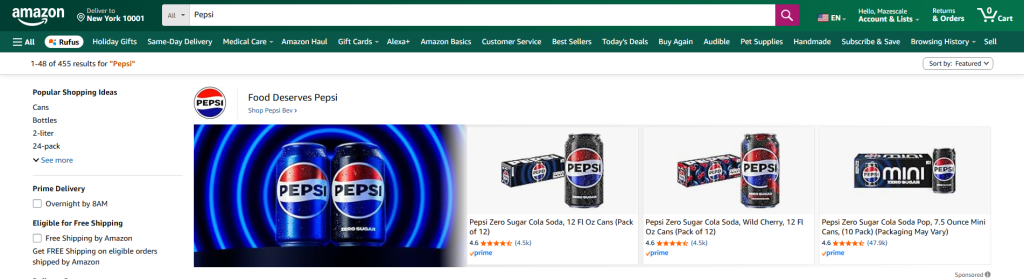
Imagine never losing your branded search placement again. Amazon recently made that possible—for a price.
Traditionally, owning the top of the search results for your own brand name required constant vigilance in real-time auctions. You’d bid, monitor, and hope a competitor didn’t outspend you on your own doorstep. Now, Amazon’s new Reserve Share of Voice (RSV) for Sponsored Brands allows brands to bypass the auction entirely.
What is it?
Instead of bidding in real-time, Brand Registry owners can now pre-purchase top-of-search placements for branded terms at a fixed cost. You essentially “rent” the space for a set period, ensuring your brand is the first thing customers see when they look for you.
No more wondering if you’ll show up. Now, you own the space.
The Mechanics
- Fixed Pricing: You move from a Cost-Per-Click (CPC) model to a fixed rate, providing budget predictability.
- Locked Parameters: Once a campaign is set (between 30 and 92 days), you cannot change the keywords or the budget.
- Inventory Control: Amazon targets a near-total impression share. In early testing, brands saw Top-of-Search visibility jump from an average of 62% to over 99%.
How to Audit Your Own Brand Defense
This isn’t a fit for every brand, and in some cases, it could be more expensive than the status quo. However, it is a strategic tool for those tired of defending their “home turf.”
Here is how to test if it makes sense for your business:
- Pull branded keyword spend: Look at your data from the last 30–90 days.
- Identify Impression Share: Check your current Sponsored Brand impression share (e.g., if you’re at 85%).
- Calculate the Gap: Estimate the additional cost required to hit 100% coverage via traditional bidding.
- Compare with Amazon’s Proposal: Request an RSV quote and see if the fixed rate is comparable to your current spend for 100% coverage.
Is This Right For You?
In many tests, the fixed rate offered by Amazon was roughly equivalent to what brands were already spending for 90% coverage. By switching, they gained that final 10% of “stolen” traffic for a marginal difference in cost.
If you are constantly defending your brand terms or losing share of voice to aggressive competitors, this shift from “bidding” to “owning” is worth a look.