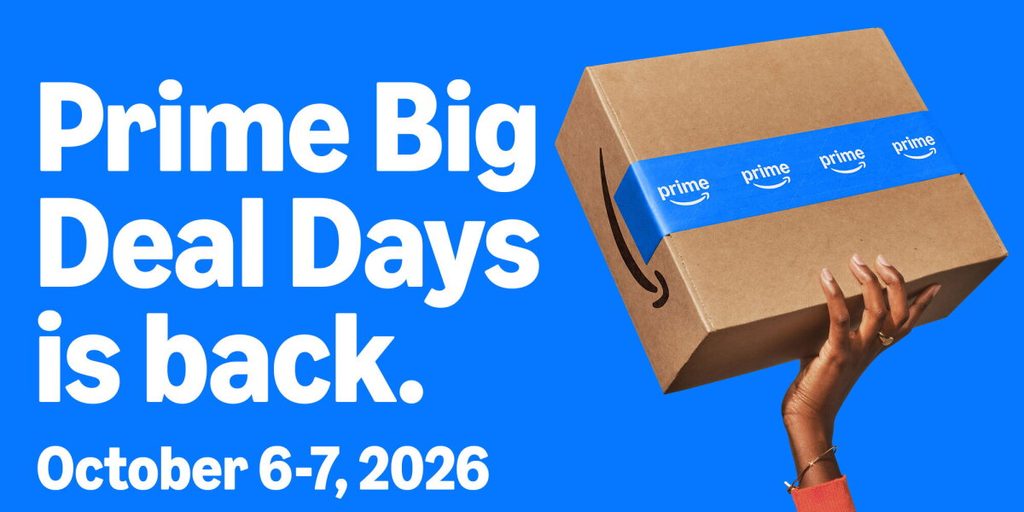
Amazon confirmed the dates on 15 September: Prime Big Deal Days runs 6–7 October 2026, opening at 12:01am PDT on the 6th and closing at 11:59pm PDT on the 7th. Prime members in 22 countries get their own version of the event, including the UK, Australia, Canada, Germany and Japan. Dates vary slightly by marketplace, so check yours.
Two days. That’s the event. But if you’re only thinking about two days, you’ve already mispriced the problem.
Here’s what actually matters for your advertising between now and the middle of October.
1. The sale is 48 hours. The demand curve is three weeks.
Early deals went live on 15 September, the same day the event was announced. The Prime Card 10%-back promotion runs 15 September through 6 October. Amazon is running a Grubhub offer from 14 September to 5 October and an Autos promotion from 15 September to 7 October.
Read that as what it is. Amazon has spent three weeks pulling shoppers into the funnel before the discounts land.
Those shoppers are browsing, comparing and adding to lists right now. They’re generating impressions on your keywords right now. They’re just not converting yet. So if you judge your campaigns on ROAS over the next fortnight and cut bids accordingly, you will systematically defund exactly the terms that are about to convert.
What to do: Accept a softer ACOS from about 26 September onward on your core, high-intent terms. You are buying position in a consideration window, and the return shows up on 6–7 October, not the day you spend it. Set that expectation for the fortnight before you’re staring at the numbers, not after.
2. Three deal drops a day will break a flat daily budget
This is the detail most sellers will miss. Amazon has confirmed that new deals drop three times daily, at midnight, 8am and 1pm PDT, and that deals run only while stocks last. Shoppers have been told, explicitly, to come back at each drop.
That’s not one demand curve across a day. It’s three spikes.
A flat daily budget doesn’t know that. If your budget exhausts at 11am because the midnight and 8am waves ate it, you are invisible for the 1pm drop and every hour after it. You paid full freight for the least competitive third of the day, then went dark for the rest.
What to do:
- Raise daily budgets on your priority campaigns well beyond what you think you need for the 6th and 7th. An unspent budget costs nothing. An exhausted one costs you the afternoon.
- If you’re running dayparting, revisit the schedule. Your normal hourly weighting is built on a normal demand pattern that will not apply on those two days.
- Check budgets mid-morning on the 6th, not at end of day. By the time the daily report tells you a campaign capped out, the window is gone.
3. Price History means a weak discount now costs you twice
This one is new, and it’s underrated. Shoppers can now pull up 365 days of price history on hundreds of millions of products straight from the detail page, and Alexa for Shopping will alert them when an item hits a target price, or buy it automatically when it does.
The practical effect: a discount that isn’t a genuine low is now visibly not a genuine low.
If you advertise into that, you pay the elevated event CPC, win the click, and lose the conversion to a shopper who just checked that your “deal” price was your normal price in July. Your ACOS absorbs the whole cost of that comparison.
What to do: Run your ad budget behind the offers that hold up against your own last twelve months of pricing. Where the discount is thin, don’t fund aggressive bids into it. That traffic converts better for someone else, and you’re paying peak rates to find that out.
4. Build now. Don’t launch on the day.
Every campaign you create on 5 October goes into the busiest, most expensive 48 hours of the quarter with no performance history, no bid data and nothing for Amazon to optimise against. You are buying the learning period at peak CPC.
Anything new needs to be live and accumulating data by around 26 September to be worth anything on the 6th. That covers campaigns, ad groups, keyword sets, and any new product launch you want visible during the event.
After that date, the job changes from building to steering: bids, budgets, placements, negatives. Not structure.
5. Check inventory and Buy Box before you touch a single bid
Nothing wastes money faster than winning clicks on an ASIN that’s about to stock out. And if you lose the Buy Box entirely, your Sponsored Products ads for that ASIN simply stop serving. Not “serve inefficiently.” Stop.
Before you raise anything, go product by product:
- Will this ASIN hold stock through 7 October at an elevated sell-through rate?
- Do I hold the Buy Box on it consistently today?
- If it sells out on the 6th, what’s the plan? Pause the ads, or redirect that budget?
Fund the ASINs that can actually take the volume. Scaling spend on a product that runs dry at noon on day one is just a donation.
6. Plan the ramp-down before you plan the ramp-up
The 8th of October is a cliff. Demand falls away hard, and every seller who raised bids for the event and then went back to normal life spends the following week paying event-level CPCs into post-event traffic.
Decide now what happens on the 8th. Write the bid numbers down before the event, while you’re still thinking clearly, because you will not want to do it on the 8th.
One caveat: don’t crash everything to zero. Q4 doesn’t end on the 7th. Halloween, the Top 100 Toys list and the Holiday Shop are all ramping straight through. Step back down to a considered baseline, not a full retreat.
7. How to read the results (and how not to)
Two days of data is not a verdict on anything.
The temptation on the 8th is to look at event ACOS, find it ugly, and start cutting. Don’t. Peak-event data is distorted in both directions. CPCs are inflated, conversion rates are inflated, and neither reflects your normal trading conditions. A keyword that looked terrible on the 6th may have been perfectly efficient. A keyword that looked brilliant may have been riding a discount you’ve now ended.
Give it seven days minimum before you restructure anything, and read the event window and the week after it together rather than separately. The honest question isn’t “what was my ACOS on the 6th.” It’s “what did the whole three-week period cost me, and what did it return in total sales, including the organic rank I bought.”
The three-week plan
| Window | Focus |
|---|---|
| 16–25 Sept | Build and fix. New campaigns live, inventory and Buy Box audit done, pricing checked against your own 12-month history, budget headroom confirmed. |
| 26 Sept – 5 Oct | Ramp. Bids up on core terms, accept softer ACOS, no structural changes. Write down your 8 October bid targets now. |
| 6–7 Oct | Steer. Budgets checked mid-morning, not end of day. Watch for midday budget exhaustion ahead of the 1pm drop. Pause ads on anything that stocks out. |
| 8–14 Oct | Step down, don’t stop. Return to your pre-written baseline. Hold off on judgement and restructuring until you have a full week. |
Most of the money lost during Prime events isn’t lost to bad bidding on the day. It’s lost to a budget that ran out at 11am, an ad group still pushing a sold-out ASIN, and a panicked round of cuts on the 8th based on two days of distorted data.
Those three are all avoidable, and all of them are decided before the event starts.